
How to Choose a Thoughtful Gift Without Gift-Giving Anxiety

The perfect present isn’t the point. To learn how to avoid gift-giving anxiety, focus on what you can control: choose a gesture that reflects the recipient’s interests, set a comfortable budget and give yourself time to plan. You can’t control exactly how someone responds, but a thoughtful choice doesn’t have to be perfect to feel meaningful.
It’s easy to turn a kind gesture into a test: Will they love it? Is it enough? Have you missed something obvious? That pressure can take the fun out of giving, especially when you’re organising gifts for family or a group.
This guide explains what gift-giving anxiety can feel like and offers practical ways to ease the pressure. You’ll learn how to choose a gift around the person, consider experiences and simple, meaningful gestures, and let go of the idea that you need to get everything exactly right. A little planning can make giving feel more personal and a lot less like a performance.
Table of Contents
Accepting limited control over how gifts are received
You can choose with care, but you can’t decide how someone will respond. These steps keep your attention on what you can influence.
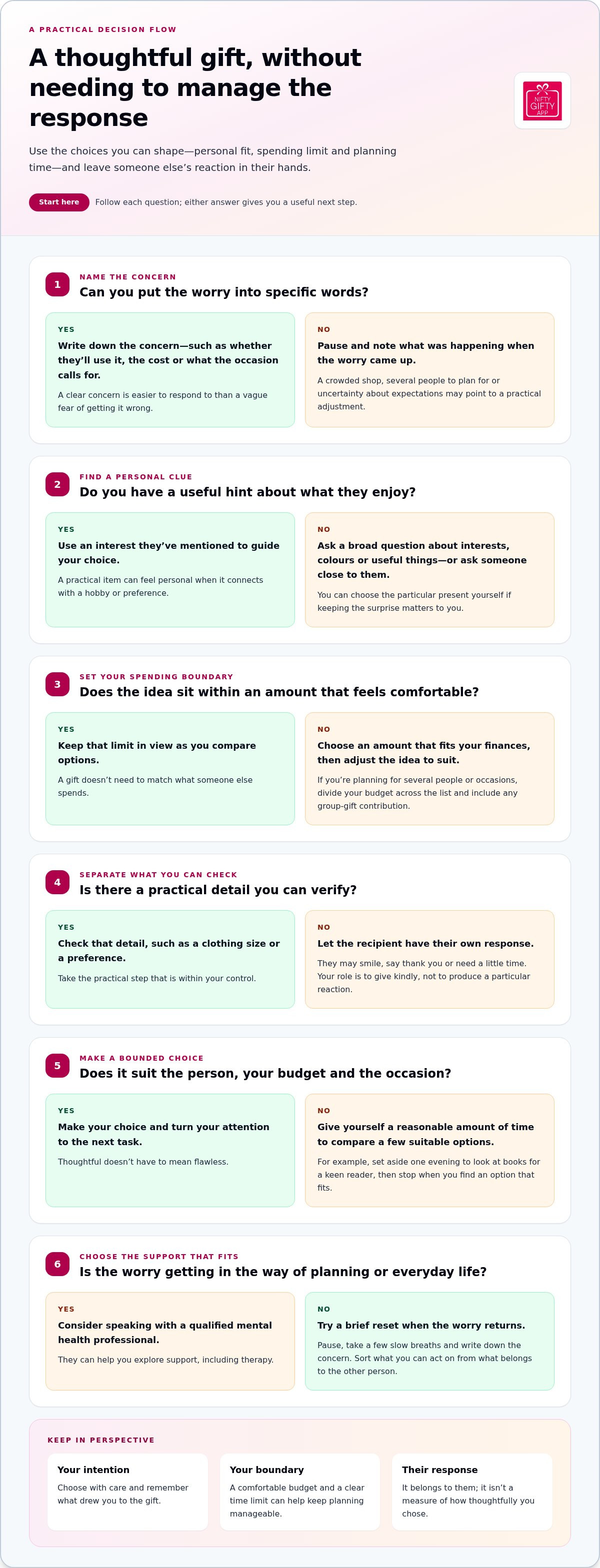
Separate your intention from the recipient’s reaction. Write down why you chose the gift, such as “she loves gardening” or “we can enjoy this together.” That gives you a clear reason to stand by your choice, even if their reaction is quieter than you imagined. A subdued response doesn’t automatically mean the gift was thoughtless.
Ask about preferences without spoiling the surpriseAsk a broad question about interests, colours or useful items, then choose the specific gift yourself. For example, ask, “What have you been enjoying lately?” or “Is there anything you’d like for the kitchen?” You can also ask someone close to the recipient for ideas. Avoid asking them to name the exact present if keeping the surprise matters to you.
Set a limit on what you’ll decide. Pick a budget that feels comfortable, choose a reasonable time to look, then stop when you’ve found an option that fits. For example, give yourself one evening to compare a few books for a keen reader. Revisiting dozens of choices can feed the worry that there’s a perfect answer hiding somewhere.
Consider practical steps or therapyUse a simple routine when worry rises: pause, take a few slow breaths and write down the specific concern. Then separate what you can act on, such as checking a clothing size, from what you can’t control, such as the recipient’s reaction. If anxiety keeps disrupting gift planning or everyday life, speaking with a qualified mental health professional can help you explore support, including therapy.
Plan for different reactions without trying to manage them. A recipient might smile, say thank you or need time to take in a surprise. Your part is to give the present kindly, not to produce a particular response. If they mention a preference later, listen without treating it as proof that your earlier choice was a failure.
Use a short check before you purchase anything: does it suit the person, fit your budget and feel appropriate for the occasion? For example, a practical item can be personal when it matches a hobby they’ve mentioned. If it meets those checks, make your decision and move on to another task on your list.
Afterward, return to the reason you chose the gift rather than trying to decode every expression or pause. Your good intentions can offer comfort: you acted with care, while the other person’s experience of the present remains their own. Remembering that difference can help you leave room for a response you didn’t anticipate, without deciding that you should have chosen differently.
If you feel pulled to keep explaining your choice, take a moment to notice what you hoped the gift would convey. You may have wanted to show affection, share an interest or make the occasion feel special. Those intentions matter even when the recipient responds in a way you can’t interpret. Let the exchange end without demanding certainty about what it meant to them. Their reaction belongs to them; your thoughtful choice belongs to you.
What is Gift-Giving Anxiety?
Gift-giving anxiety is worry about choosing a present that disappoints someone, costs too much or misses an expectation. You might enjoy browsing, then feel tense in Christmas crowds or second-guess a purchase before checkout. Learning how to avoid gift-giving anxiety starts with noticing which part of giving feels difficult for you.
Name the pressure behind the worry. Before choosing anything, write down the specific concern: “I’m worried my sister won’t use this” is easier to address than “I’ll get it wrong.” The concern might involve money, etiquette, reciprocity or a busy shopping centre. Naming it helps you decide whether there’s a practical step to take, such as asking about a preference or choosing a quieter time to shop.
Notice what triggers the feeling. For example, you might enjoy shopping but feel anxious in Christmas crowds, or feel uneasy while choosing gifts for several relatives. Jot down what was happening when the worry appeared. If a crowded centre leaves you tense, make a short list before leaving home or browse at a quieter time. Spotting a pattern gives you something specific to adjust.
Set a realistic gift budget by choosing an amount that fits your finances, then dividing it among the people and occasions on your list. Include any planned group gift contributions. A clear limit can reduce financial stress without requiring you to match what relatives spend. Keep the amount private if sharing it would make the present feel like a contest.
Separate gift etiquette from assumed rules. If you’re unsure whether a present is expected, think about the occasion and your relationship with the person. For example, a family birthday may involve gifts, while a casual catch-up may not. Ask the host or a relative what the group usually does, rather than trying to infer expectations from one person’s past gift.
Address reciprocity worries with a low-pressure conversation. You could say, “I’m keeping gifts simple this year. Are we exchanging presents, or just getting together?” That lets others answer without setting a spending contest. If someone gives you an unexpected present, thank them warmly. You can decide later whether you’d like to mark another occasion with a gift of your own.
Plan early enough to avoid rushed choices. Write each recipient’s name beside an interest they’ve mentioned and a few possible ideas. If your cousin enjoys gardening, note a practical item connected to that hobby. A short list helps you compare suitable options calmly, instead of choosing under pressure or reopening the decision whenever another idea appears.
Choose one small action when worry returns. Pause browsing, take a few slow breaths or ask someone you trust to talk through one decision. Then return to the practical task in front of you. A useful way to think about how to avoid gift-giving anxiety is to focus on the next manageable step, rather than trying to settle every detail at once.
Fear of disappointing the recipient
Start with one detail the recipient has shared. A keen reader might mention a favourite author, while a keen cook might talk about trying new recipes. Use that clue as your starting point, rather than chasing a present that looks impressive. The aim is to show you noticed something about them, not to prove you know every preference they have.
Match the gift to their actual interests, not an imagined version of them. If your brother has recently taken up walking, useful socks may suit him better than expensive camping gear. Check that the idea connects to something he enjoys now. A gift based on a real interest feels more personal than an elaborate guess based on an old hobby.
Separate the gift’s price from its meaning. Spending more doesn’t guarantee a warmer response, and a modest present can still show care. For example, a favourite snack paired with a handwritten note may feel more personal than a costly item chosen without much thought. Choose something that fits your relationship and circumstances, rather than trying to purchase certainty.
Make a short list of possible gifts, then compare each with the recipient’s preferences. For a child who loves drawing, consider whether art materials match their age and the way they like to play. A parent or carer may know which supplies are useful. Keep the choice grounded in the child’s interests, not in pressure to find a present that outdoes everyone else’s.
Give sincerely across your list, without treating every present as a performance. You might feel obliged to give something to every relative, even after being told to focus on the children. Pause and decide what feels right for each relationship. A simple card or shared treat can mark the occasion without turning the family list into a test of equal spending.
Plan how you’ll respond if the recipient seems underwhelmed. A quiet “thank you” doesn’t tell you everything about what they think. Let them enjoy the moment in their own way, rather than asking repeatedly whether they like it. If they later share a preference, listen and use that information for another occasion. Their response can guide future choices, but it doesn’t define your intention today.
Use a final three-part check before you settle on an idea: does it suit the person, reflect something you know about them and feel appropriate for your relationship? For example, a practical present for a niece can be thoughtful if it supports an interest she already enjoys. Once your choice meets those checks, stop comparing it with imagined alternatives.
Giving experiences or meaningful gestures
An experience can make the gift about time together, not another object to store. Choose an option that suits the recipient’s interests and practical circumstances.
Think of an activity the recipient already enjoys or has mentioned wanting to try. A pottery class may suit someone who likes making things, while a picnic could be lovely for a relative who enjoys a relaxed catch-up. Consider their schedule, mobility and travel needs before settling on an idea. The aim is an experience they can enjoy comfortably, not another obligation to fit in.
Choose an experience or meaningful gesturePick an experience with the recipient in mind, then make the invitation personal. For example, offer to visit a local gallery together, cook their favourite meal at home or take a walk somewhere they love. Add a note explaining why you chose it. Check that the plan feels manageable for them, and avoid making the date or activity feel like a commitment they can’t change.
Make the gesture specific enough to feel like a gift. “Let’s catch up sometime” can be hard to turn into a plan; “I’d love to take you for lunch at your favourite café” gives it shape. If distance makes meeting difficult, arrange a video call and share a recipe, playlist or photo album. The personal detail is what turns an ordinary activity into a thoughtful moment.
Consider an experience gift voucherChoose a voucher for an activity the recipient is likely to enjoy, such as a cooking class or a visit to a local attraction. Before purchasing, read its conditions and check the location, booking process, available dates and any expiry details. Match the choice to the person’s preferences, not simply the most eye-catching activity. Include a note with a few ideas for how they might use it.
Think through the practicalities before giving a voucher. A class may require travel, advance booking or attendance on a set day, so consider whether those details suit the recipient. If they live in another city, choose an experience close to them rather than one that creates extra travel. A flexible plan can make it easier for them to enjoy the gift on their terms.
Offer a meaningful gesture when an experience isn’t the right fit. You could write a short letter recalling a favourite shared moment, create a small photo collection or help with a task they’ve mentioned. Keep the gesture focused on them. A sincere, specific message can carry more meaning than an elaborate present chosen without a personal connection.
Let the recipient shape the details if that makes the experience easier to enjoy. Suggest two suitable days for a meal, or invite them to choose between a gallery visit and a walk. That still leaves room for a surprise while making the plan practical. Thoughtful experiences create opportunities for shared memories, without adding an unwanted object to someone’s home.
Letting go of the perfect gift
A thoughtful present doesn’t need to be rare, expensive or perfectly matched. Use these steps to make a kind choice without turning it into a test.
Choose a thoughtful gift without overthinkingPick one interest the recipient has shared, then choose a gift that connects to it. For example, a keen gardener might appreciate a useful tool, while a book lover could enjoy a story in their favourite genre. Settle on an option that suits the person and the occasion. Avoid reopening the decision every time another possibility appears.
Consider cash, gift cards or second-hand giftsChoose cash, a gift card or a second-hand item if it suits the recipient and your relationship. In Australia, these can all be thoughtful options; consider the person’s preferences and the occasion. A second-hand cookbook may delight someone who loves collecting old editions. For a gift card, pick a place they use and present it with a personal note.
Handle group gift exchanges without pressureAgree on the exchange details before choosing a present. In a workplace or family group, ask what the spending limit is and whether taking part is optional. If the plan doesn’t suit your budget or circumstances, say so politely. For a shared present, suggest one practical idea and let the group decide together, rather than carrying the whole decision alone.
Give a simple gift with a clear, sincere explanation. Try, “I remembered you said you wanted to try this,” or, “I thought you’d enjoy this book.” A useful present can be funny, sweet, sentimental, educational or simply well suited to daily life. The explanation connects the item to the person, without apologising for its size or price.
Choose a stopping point before you begin comparing options. Write down the recipient’s interest, your suitable ideas and the one you’ve selected. For example, if a child enjoys drawing, art supplies, a book or a small toy could each make sense. Once your choice fits, leave the other possibilities alone. More browsing can create doubt without adding meaning.
Let the relationship matter more than a family gift contest. You don’t need to compete with another aunt, uncle or grandparent to be someone’s favourite. A present chosen with care, such as a book connected to a child’s current interest, can be enough. Focus on the connection you share, not on matching what another relative gives.
Focusing on the thought behind a gift, rather than seeking a perfect present, can make gift-giving less stressful. The author says she bought her niece and nephew their main gifts along with clearance clothes, books and small toys.
She suggests useful gifts can be funny, sweet, sentimental, educational or random. The author also says she realised she need not compete with her nieces’ and nephews’ other aunts to be their favourite aunt. Remembering what matters in the relationship can help keep the gesture enjoyable.
Nifty Gifty App
Nifty Gifty App helps you organise gift lists when several people are coordinating an occasion. Use the mobile app on iOS or Android to keep gift ideas and claims in one place. Guests can claim gifts through a secure link or QR code, without downloading the app or creating an account, and claims update in real time. For a group gift, the app tracks contributions with a live running total; contributors arrange payments separately.
It’s a practical fit for family organisers, busy parents and relatives coordinating across cities. You choose the thoughtful gesture; the app helps keep the details together.
Visit niftygiftyapp.com to explore Nifty Gifty App.
Make room for the joy of giving
Let the next occasion be a chance to make your approach simpler. Before it arrives, decide what you want giving to feel like: personal, relaxed, shared or easy to manage. That intention can guide your choices when new ideas and expectations start competing for attention.
Learning how to avoid gift-giving anxiety isn’t about controlling every detail. It’s about making a considered choice, then giving yourself permission to move on. Keep the process in proportion to the relationship. A small gesture can mark a moment; a shared plan can help a group take part without leaving one person to coordinate everything.
If you’re organising gifts for family or friends, make the next occasion easier to keep track of. Explore Nifty Gifty App and find a simple way to organise your gifting.
Thoughtfulness doesn’t need to feel like pressure. Give with care, stay true to what feels manageable and leave room to enjoy the occasion too.
Frequently Asked Questions
What causes anxiety about giving gifts?
Gift-giving anxiety often comes from pressure to choose the “right” present while managing expectations, spending and social etiquette. It can feel sharper when several occasions fall close together, or when a family tradition makes gifts feel like a test of affection. For example, comparing your present with a sibling’s elaborate gift can turn a kind gesture into a competition. Remember, someone else’s choice doesn’t set the standard for yours.



Comments