
How to set a fair price and format for a family gift exchange

Good family gift exchange rules start with an agreed spending cap, a clear gift format and a simple way to decide who gives to whom. In a White Elephant exchange, each player brings one wrapped gift for the shared pool, then takes a turn choosing an unopened gift or stealing one that’s already been opened.
If the exchange no longer suits everyone, opting out can be part of the plan. Gifting should feel thoughtful, not like another expense or obligation.
This guide will help you set a fair budget, choose rules that fit your group and pick a game format for family, friends, colleagues or children. You’ll also find practical ways to accommodate different budgets, keep the rules easy to follow and make room for people who’d rather sit this one out.
Table of Contents
Basic White Elephant gift exchange rules
Clear family gift exchange rules help everyone know what to bring and how each turn works. In a White Elephant game, every participant brings one wrapped gift for a shared pool, then takes a turn choosing or stealing a present.
Agree on the format and stealing limits before the gathering. These family gift exchange rules keep the game moving and give everyone the same expectations from the start.
Define a White Elephant exchangeChoose a White Elephant exchange when you want everyone to contribute one anonymous, wrapped gift to a shared pool. Players take turns selecting an unopened present or stealing one another player has opened. Ask participants to avoid hints or spoilers so every gift stays a surprise. Before anyone prepares a gift, decide whether regifted or thrifted items are welcome or whether gifts must be new.
Compare exchange formatsPick the format that suits your family’s appetite for surprises. White Elephant and Yankee Swap commonly involve a shared pile, a turn order and the option to steal an opened gift. A themed exchange adds a gift brief, such as handmade ornaments or a theme with a budget under A$20. Tell everyone what fits the theme before they choose a present, rather than leaving participants to guess.
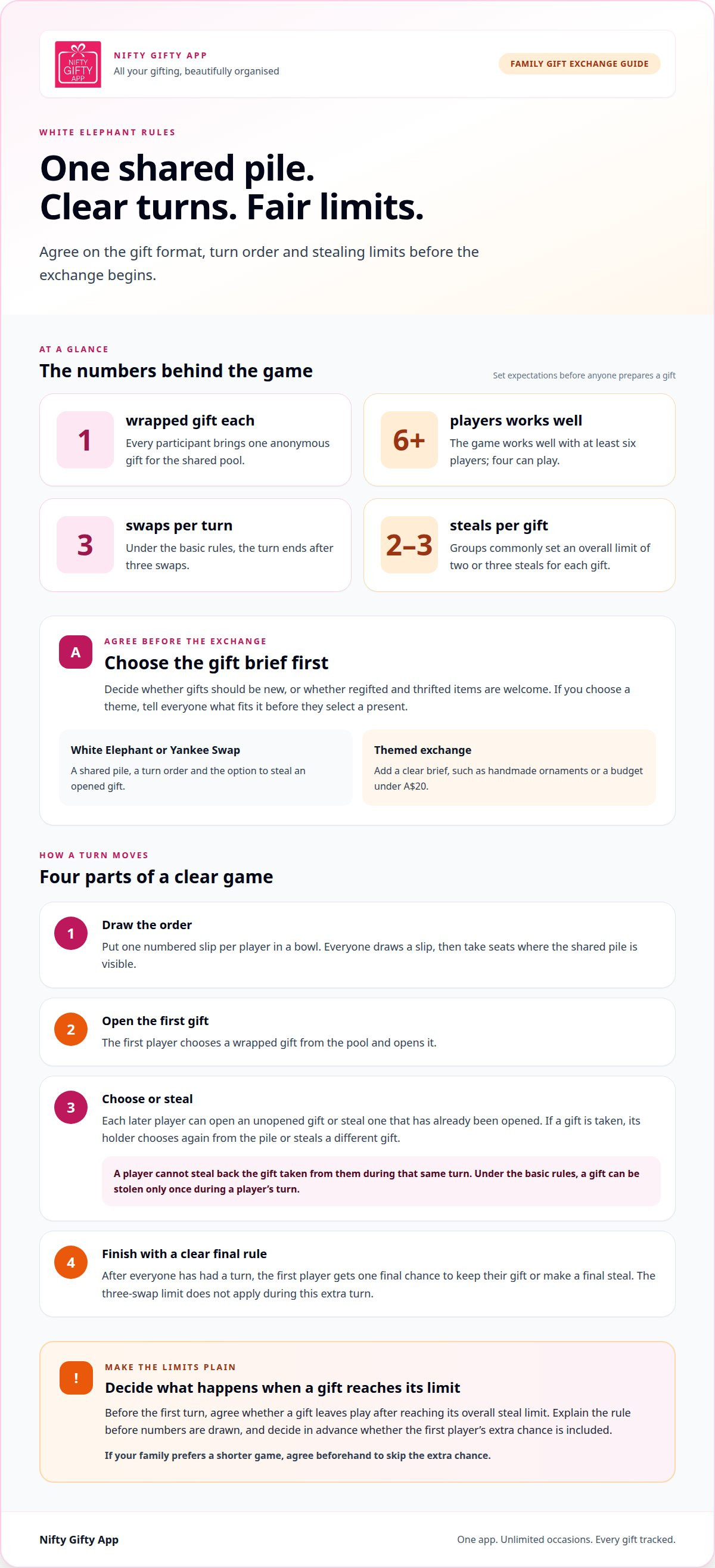
Run a family gift exchange drawSet the gift type and spending cap first, then ask each participant to bring one wrapped present. Put one numbered slip per player in a bowl and have everyone draw one to decide the order. Seat participants where they can see the pile. A White Elephant game works well with at least six players, though four can play.
Explain each turn before the first player starts. They choose and open a gift from the pool. Each later player can select an unopened present or steal one that’s already been chosen. If someone’s gift is taken, they immediately choose again from the pile or steal a different gift. They can’t steal back the gift taken from them during that same turn.
Set stealing limits before play begins. Under the basic rules, a gift can be stolen only once during a player’s turn, and the turn ends after three swaps. Groups commonly limit each gift to two or three steals overall. Decide whether a gift leaves play after reaching its limit, and explain the rule before the first turn.
After everyone has taken a turn, give the first player one final chance to keep their gift or make a final steal. The three-swap limit doesn’t apply during this extra turn. If your family prefers a shorter game, agree beforehand to skip the extra chance. Explain the rule before numbers are drawn, rather than changing it partway through.
Gift exchanges for friends, family, colleagues, and children
Set fair rules by agreeing on the budget, gift style and participants before anyone starts shopping. For children and adults, match the exchange format to their ages and relationships.
For a family draw where each person gives to one relative, every participant draws a name and prepares one present for that recipient.
Include children and teenagersDecide whether children join the adult exchange or have a separate gift circle. Children under about 12 usually do better outside an adult draw, while teenagers aged 13 and older can join the adult pool with a lower budget. One suggested teen budget is A$25-A$30. Keep each gift age-appropriate, especially if children are sharing a game or activity.Ask each participant for three to five wishlist ideas at different prices, all within the agreed limit. A teenager might list a book, art supplies and a favourite game. This gives the giver options without making the present feel impersonal. Set the same rules for relatives of similar ages, so nobody wonders why one cousin has different expectations.
Buy gifts only for childrenChoose a children-only exchange if the adults want to reduce the number of presents. State which children are included, who will buy each gift and whether siblings are included on the same terms. For example, one adult could be responsible for each child, rather than asking every relative to buy for every child.Keep the arrangement clear for adults who aren’t participating. A family of eight giving to every other member would need 56 presents, so limiting the exchange to children can substantially simplify the gift list. Tell relatives the plan directly, and explain that opting out of adult gifts applies consistently across the circle.
Run a one-to-one family gift drawUse a name draw when each person should give one thoughtful present to one recipient, rather than buying for the whole family. Have the organiser prepare a private draw, then tell each participant whom they’re gifting to. Set a spending cap and gift deadline before names are shared, so distant relatives have time to post presents.For a Christmas exchange, set a sign-up deadline two to three weeks before the gathering. Keep the draw fair by preventing participants from selecting themselves and planning how to handle pairings between close household members. Share the same rules with everyone, including relatives joining from elsewhere.For friends, colleagues or a themed exchange, add one clear instruction, such as a shared theme or suitable gift type. At work, make participation and the spending limit clear to colleagues. Among friends, a theme can make choosing easier, but it should still leave room for personal taste. One rule sheet can cover the budget, recipient, theme and exchange date.
Setting spending limits or restricting gift types
Agree on the budget and gift expectations before anyone buys a present. A clear cap, simple privacy rules and agreed swap limits make the exchange easier to follow.
Set one spending limit that suits the group. White Elephant groups commonly choose a cap between A$20 and A$30. Extended-family name draws may use A$25, while closer-family exchanges may choose A$50-A$75. Pick a figure everyone can manage, then say whether it includes postage. Don’t compare gifts by size or price on the day.
Decide what participants can bring. A holiday exchange might call for a wrapped gift, a handmade ornament or a useful household item. State whether gifts may be thrifted or regifted, or must be new. Be specific about the theme and avoid vague prompts that leave participants guessing. Share the same instructions with everyone.
Agree on steal and swap limitsChoose the steal limit before the first turn, then explain what happens when a gift reaches it. Groups commonly cap each gift at two or three steals. Under the basic rules, a player whose gift is taken chooses again immediately but can’t steal back that same gift during the turn.Set a swap limit too. The basic game ends a turn after three swaps, but groups can agree on another clear limit beforehand. Explain whether a locked gift is out of play, so nobody tries to steal it after the rule has closed that option.
Include people who cannot afford giftsChoose a cap people can meet without pressure, and make participation optional. A family can lower the budget, run a children-only exchange or welcome handmade gifts. Tell relatives privately that they can sit out, rather than asking them to explain their circumstances in front of the group.Keep the same expectations for everyone. Don’t add a costly extra gift for hosts or relatives who aren’t in the draw. A thoughtful card or shared time can be part of the gathering without becoming another purchase requirement.
Agree on privacy and gift etiquette before Christmas or another gathering. Keep recipient names and gift hints within the exchange, and don’t share someone’s wishlist without permission. Ask participants to avoid spoilers, teasing about gift value or pressuring others to reveal who gave what.
Set a rule for unwanted or duplicate gifts before the exchange. Decide whether regifting is allowed, whether a gift can be swapped and whether it stays with its recipient after play. If a duplicate appears, let the recipient decide what to do with it. Don’t assume they must exchange or keep an item they don’t want.
Themed and alternative game formats
A theme gives participants a shared starting point without making every present identical. Choose the format before sending the invitation, then explain what each person should bring.
Pick one clear theme, such as locally made goods, cosy comforts or something useful for a picnic. Ask everyone to bring one wrapped gift that fits, and spell out what counts. “Something for a picnic” leaves room to choose a picnic blanket, reusable cup or outdoor game. A defined theme keeps the exchange focused without turning gift selection into a competition.
Make the theme suit the people attending. A family dinner with young children might feature favourite storybooks, while a friends’ gathering could centre on snacks or hobbies. Choose a category most participants can interpret in different ways. Avoid themes that depend on specialist knowledge, specific shops or a narrow taste shared by only some of the group.
Consider a regift theme if participants agree beforehand. It gives an unwanted item a new home, but set simple rules: gifts should be clean, complete and suitable for the recipient group. Don’t wrap something broken or pass along an item with someone’s name still attached. Explain that regifting is optional, so nobody feels obliged to find an item at home.
Try a handmade exchange for relatives who enjoy making things. A handmade ornament can travel in a light box measuring 4 by 4 inches, which suits a small tree decoration. Ask participants to label fragile items and wrap them securely. Make the theme about the effort or craft, not artistic skill, so children and adults can take part comfortably.
Use a simple reveal activity to add a game without changing the gift rules. For example, ask each giver to share one clue about their wrapped present before the recipient opens it. Keep clues kind and broad, such as “you can use this outside”. Skip clues that identify the giver or reveal private details. This adds a moment of guessing without a complicated scoring system.
Choose a no-steal format if the group prefers a calmer exchange. Put all wrapped gifts on a table, then have participants draw numbers to choose one in order. The group can keep the format simple by opening selected presents without adding further turns. If someone receives an unsuitable gift, let them discuss a polite exchange afterwards rather than interrupting dinner.
Include the format and theme in the invitation, with an example of an acceptable gift. State whether gifts should be handmade, regifted or newly purchased, and whether wrapping is expected. For relatives joining from elsewhere, include delivery timing and the recipient’s name on the outside. Clear instructions help everyone prepare the right gift and enjoy the occasion.
Opting out of family gift exchanges
Giving a holiday gift can be lovely, but joining an exchange shouldn’t feel compulsory. If the family tradition no longer suits someone’s budget or circumstances, make opting out a clear, respectful option.
Tell the organiser privately as soon as you decide. A short message such as “I’m sitting out the gift exchange this year, but I’d still love to come for dinner” gives them time to adjust the participant list. You don’t need to explain your finances or offer a substitute present. Keep the conversation warm and direct.
Make participation optional for everyone. One relative’s decision shouldn’t trigger questions or pressure to rejoin. A family exchange continued for four years before one participant said they could no longer afford it. Treat that choice as practical information, not a judgement about how much they care for the family.
Decide whether opting out means skipping only the exchange or all gift giving. Some families continue exchanging presents with children while adults sit out. Others share a meal, card or activity instead. State the plan clearly in the family message, so nobody arrives expecting an extra holiday gift from someone who opted out.
Keep the draw fair for those who remain. Ask the organiser to remove the person’s name before assigning recipients, then tell participants privately if the change affects their match. Don’t leave an opened gift or name slip in the draw after someone withdraws. A quick update avoids confusion without turning the decision into a group debate.
Agree how to handle gifts already purchased. If someone has prepared a present before opting out, they can decide whether to give it separately or keep it for another occasion. Don’t expect them to contribute to a shared gift after leaving the exchange. The organiser can update the plan without asking for personal details.
Have a simple response ready if relatives ask why. “I’m keeping gift giving smaller this year” is enough; the person can add details if they wish. Don’t announce someone else’s decision in the family chat or explain their finances on their behalf. For a White Elephant exchange, clarify whether they’re still attending without bringing a wrapped gift.
Keep the invitation welcoming after someone opts out. Include them in the meal, family photos and conversation rather than treating the exchange as the main event. If the family wants a different tradition, suggest a shared activity that doesn’t require a present. A kind, consistent response makes future choices easier for everyone.
Nifty Gifty App
Nifty Gifty App helps organisers keep gift lists and group contributions organised in one place. Use the mobile app on iOS or Android to organise gifts for family gatherings, friends and colleagues.
Guests can claim gifts through a secure link or QR code, without downloading the app or creating an account. Claims update in real time, so the organiser can see which gifts have been claimed. For a group gift, contributors can contribute while the app tracks a live running total. Payments happen separately; the app doesn’t collect or process them.
Use it when your exchange involves shared gift lists or contributions and you want the details gathered together. To see how Nifty Gifty App can support your next occasion, visit niftygiftyapp.com.
Make your next exchange feel right for your family
Before the next occasion, turn your decisions into a short message everyone can refer to. Say who’s participating, what the exchange involves and how people can tell the organiser about a change. A clear note gives relatives room to join, suggest a different arrangement or sit out without making gifting the centre of the gathering.
Good family gift exchange rules should support the people taking part, not become a test of generosity. Keep the plan flexible enough for changing budgets, growing families and relatives who live further away. If you’re coordinating gift lists or group contributions alongside the exchange, Nifty Gifty App helps keep those details together.
Explore Nifty Gifty App for your next occasion, and make space for the part everyone came for: sharing time together.
Frequently Asked Questions
Get one, give one, what could be simpler?
A one-for-one exchange keeps each person’s giving focused on one recipient. Before setting it up, decide how to include partners, people joining remotely and relatives who can’t attend. For example, someone who’s away could send their present ahead, while another person reads their name during the gathering. Clear plans for absent participants help the exchange feel inclusive without adding surprise gift obligations.
What are common rules for a family gift exchange?
Agree on participation, gift expectations and what happens if someone can’t attend. Make a simple plan for late arrivals: the organiser can hold their gift until they arrive or arrange delivery afterwards. If family members are spread out, decide who’ll post gifts and how recipients will be identified. Share these details in one message, so relatives can refer back instead of relying on separate chats.
How do you set a budget for a family gift exchange in Australia?
Choose a spending cap the group can manage, then decide whether postage sits inside it. For example, an A$40 total budget with A$12 allocated to postage leaves A$28 for the present. Say whether the cap applies per person or per household, particularly when couples give together. State the amount clearly before participants purchase gifts, and make sure everyone is working from the same total.
What are the rules for a White Elephant or one-recipient gift exchange?
For White Elephant, set the gift and stealing rules before play. For a one-recipient exchange, each participant draws a name and prepares a gift for that person. Decide whether the recipient’s identity stays private until the exchange and how to handle a draw that pairs people from the same household. These small choices help the format suit your family and avoid awkward pairings.
How do you organise a family gift exchange with a large group?
Start with one organiser and a final participant list. Then group relatives by household or age where that makes the exchange easier to manage. For example, a family might run separate draws for adults and children, or assign one gift per household. Set a clear reply deadline and ask each household to confirm who’s taking part, so the organiser can prepare the right number of pairings.
What are good family gift exchange themes and gift ideas in Australia?
Choose a theme with plenty of room for personal taste. Australian-made pantry treats, a useful picnic item or something for a favourite activity can suit different ages and interests. Give participants a short description rather than a strict product list. For instance, “something for a weekend outdoors” could inspire a reusable cup, a sun hat or a compact game, all within the agreed spending cap.



Comments